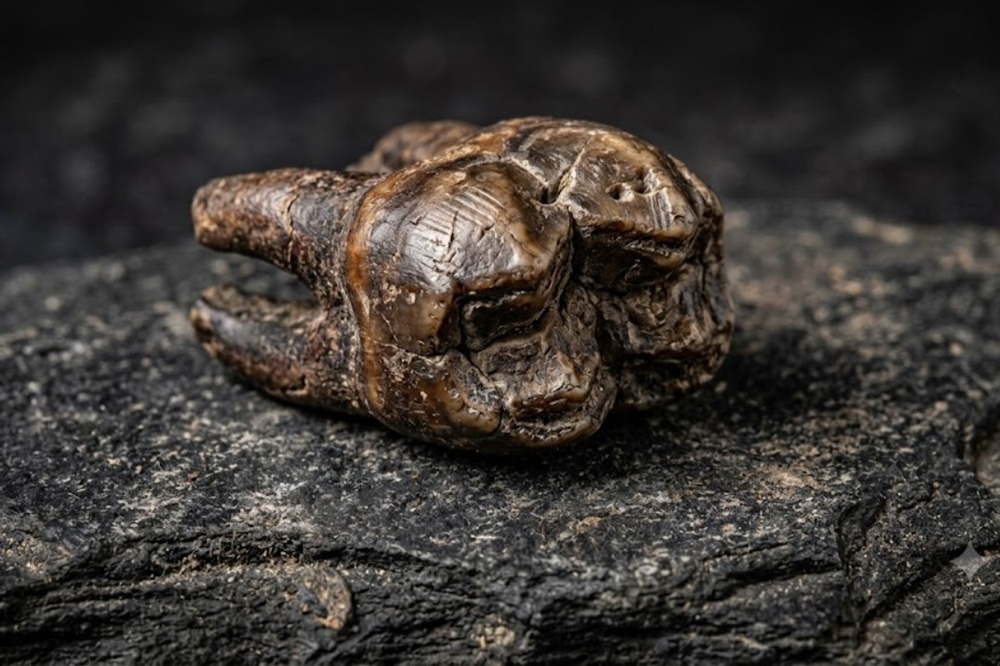
Neanderthals Were Drilling Teeth 59,000 Years Ago
A lower second molar pulled from a Siberian cave tells an uncomfortable story. The tooth shows three stages of deliberate drilling — stone tools worked down through enamel, through dentine, all the way to the pulp — on what researchers believe was a deep bacterial cavity. The individual who owned that tooth went on to use it for chewing, probably for years afterward. Which means the procedure, as brutal as it sounds, did something useful.
The find, reported by Kseniya Kolobova at the Russian Academy of Sciences, pushes the earliest confirmed evidence of dental intervention back by roughly 45,000 years. Prior to this, the oldest known attempt at treating a cavity dated to around 14,000 years ago, found in an Italian site. Neanderthals, as a species, were already extinct before agriculture existed. They had no metal instruments, no anaesthetic, no suction. Just a stone tool and a problem that needed solving.
What “drilling to the pulp” actually meant
Reaching the pulp of a tooth is not minor. The pulp chamber is where the nerve lives. Any modern patient who has had an untreated cavity progress that far knows the specific quality of that pain — it doesn’t stay in one place and it doesn’t go away on its own. A Neanderthal with a deep enough abscess would have been in constant, possibly debilitating discomfort.
Drilling into the pulp — even with a stone bore, even without pain relief — would have drained the infection and, in many cases, provided real relief. Not comfortable. Not clean by any modern standard. But functional. The evidence that this individual kept using the tooth suggests the intervention stabilised something that was getting worse.
Honestly, that’s more than a historical curiosity. It’s a reminder that the instinct to treat dental pain is not a product of modern medicine — it’s just old. But it’s not quite the same as engaging a dentist in Richmond for your teeth issues.
A longer history than most people assume
Dental care has pre-modern roots that go well beyond this discovery. Beeswax fillings found in a 6,500-year-old Slovenian tooth suggest that early humans were sealing cavities long before anyone had formalised the idea of dentistry. Intentional tooth-picking — evidence of deliberate oral hygiene — appears in Neanderthal remains from Croatia dating back around 130,000 years. Chewing sticks appear in ancient Egyptian texts.
The Siberian molar adds something specific: not just hygiene or rudimentary fillings, but a staged, multi-step procedure aimed at treating an active infection. Three separate stages of drilling implies someone who understood that the problem was deep, and worked toward it systematically.
Why this matters beyond the history
The gap between a Neanderthal boring into a tooth with a flint tool and a modern dental practice in 2026 is, obviously, enormous. Pain management, infection control, precision instruments, digital imaging — none of that existed in a Siberian cave 59,000 years ago. The materials alone represent tens of thousands of years of accumulated knowledge.
But the underlying logic hasn’t changed. Dental pain that goes untreated gets worse. An infection contained is better than one that spreads. And the discomfort of treatment — however significant — is usually far less than the discomfort of leaving the problem alone. That calculus was apparently clear enough to a Neanderthal that they sat through a stone-tool procedure on an exposed nerve.
Modern dentistry exists to make that calculation easier, not different.