Why Australians Are Rethinking Their Balcony Balustrades
Balconies have become one of the hardest-working parts of the modern home. In cities where land is tight and apartment living is the norm, that slab of outdoor space is often the only fresh air a household gets. It has multiple uses including a spot for a coffee, a barbecue, or just watching the world go by. But the thing standing between you and a very long drop rarely gets a second thought, until something goes wrong.
That’s been on people’s minds in Sydney this week, after a 32-year-old man was seriously injured falling from the third floor of a unit in Waterloo on Tuesday night. NSW Police say officers were outside the unit as part of an ongoing investigation when the man attempted to leave via the balcony and fell; he’s since been listed in a stable condition at Royal North Shore Hospital, and the matter is now the subject of a critical incident investigation with independent oversight. The exact circumstances are still being worked through, and there’s no suggestion the balustrade itself was involved — but the incident is a blunt reminder that falls from height off balconies are a real and ongoing safety issue in a country full of multi-storey living, and that the barrier at the edge of a balcony deserves more scrutiny than most of us give it.
What actually makes a balustrade “safe”
In Australia, balustrades aren’t just a design choice, they’re a compliance issue. Under the National Construction Code, any barrier protecting a fall of one metre or more has to meet the load and height requirements set out in AS 1288 (Glass in Buildings – Selection and Installation) and AS/NZS 2208 (Safety Glazing Materials in Buildings). For glass specifically, that means toughened or laminated glass engineered to a thickness that matches the span it’s covering. As a rough guide, 8mm toughened glass is typically rated for spans up to about 1070mm between supports, 10mm for spans up to around 1650mm, and 12mm up to roughly 1930mm. But it’s important to note a licensed installer will always confirm the right spec for a given job, particularly where the design relies on the glass alone rather than a structural handrail.
None of this is meant to be alarming. It’s simply the standard that any reputable installer, builder or strata manager should already be working to. For owners in strata buildings, balustrades are usually classified as common property, which means the owners corporation carries responsibility for keeping them structurally sound, and a periodic inspection is worth budgeting for rather than leaving until a problem shows up.
Why frameless glass keeps winning out
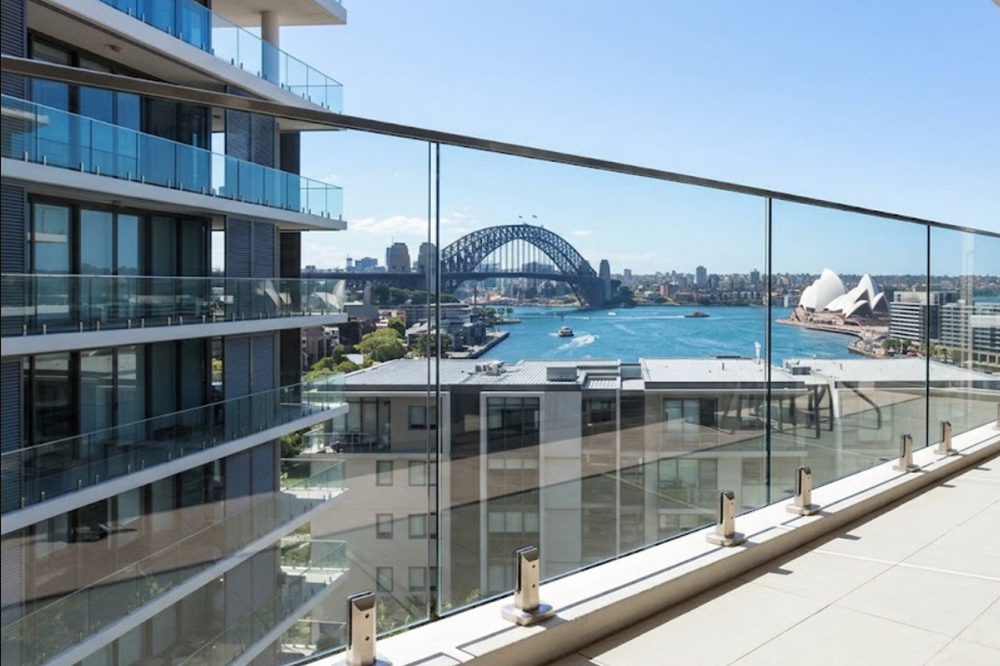
Assuming the compliance box is ticked, the bigger question for most homeowners is what the balustrade actually looks and feels like day to day — and this is where frameless glass has become the default upgrade for balconies, decks and stairwells across the country. Strip away the metal posts and top rails of a traditional design and what’s left is an unbroken sightline: the view stays the view, rather than being chopped up by framework every metre or so. For a coastal or elevated property, that alone can be the difference between a balcony people actually use and one that just sits there.
There are practical reasons behind the shift too. Toughened glass doesn’t rust, rot or need repainting the way steel and timber balustrades eventually do, which matters in salt air or exposed positions where corrosion is a constant maintenance cost. It also lets more natural light reach the space behind it, which architects increasingly lean on to make smaller apartments and courtyards feel larger than they are. Sydney installer Top Glass Fencing, for instance, says growing demand for frameless glass balustrades is coming largely from homeowners renovating older apartment blocks, where the original metal balustrade is both dated and due for replacement anyway. This makes the upgrade an easy one to justify alongside other works.
Getting it right
The trade-off is cost: frameless glass is typically a bigger upfront outlay than a standard metal rail, and it’s not a job for a handyman with a drill. Proper installation depends on precise engineering to hit the load ratings required by AS 1288, which is exactly why it needs a specialist rather than a general renovator. But for a feature that’s both structural (it’s the only thing stopping a genuine fall) and highly visible (it’s often the first thing anyone notices from the street or the pool) it’s an area where cutting corners rarely pays off.
Whatever a homeowner ultimately chooses, the underlying message from this week’s incident is a simple one: the barrier at the edge of a balcony isn’t decoration. Whether you’re renovating, buying into an older apartment block, or simply haven’t looked at your balustrade in a few years, it’s worth checking that what’s there actually meets the standard — because it’s one of the few genuinely load-bearing decisions in a home that people tend to treat as purely cosmetic.